- Going Places
- Posts
- Millennials don't want to retire, we want out.
Millennials don't want to retire, we want out.
Rewriting the end of the career story + what we actually want instead.

Janel Abrahami
March 06, 2026


Welcome to the 400 new subscribers to Going Places! I’m so happy you’re here. Did you know I put together an entire course called Pivot with Purpose? Think of it like a supercharged version of all the best content from this newsletter, tailored to help you nail your career goals.
Today, I want you to imagine retirement.
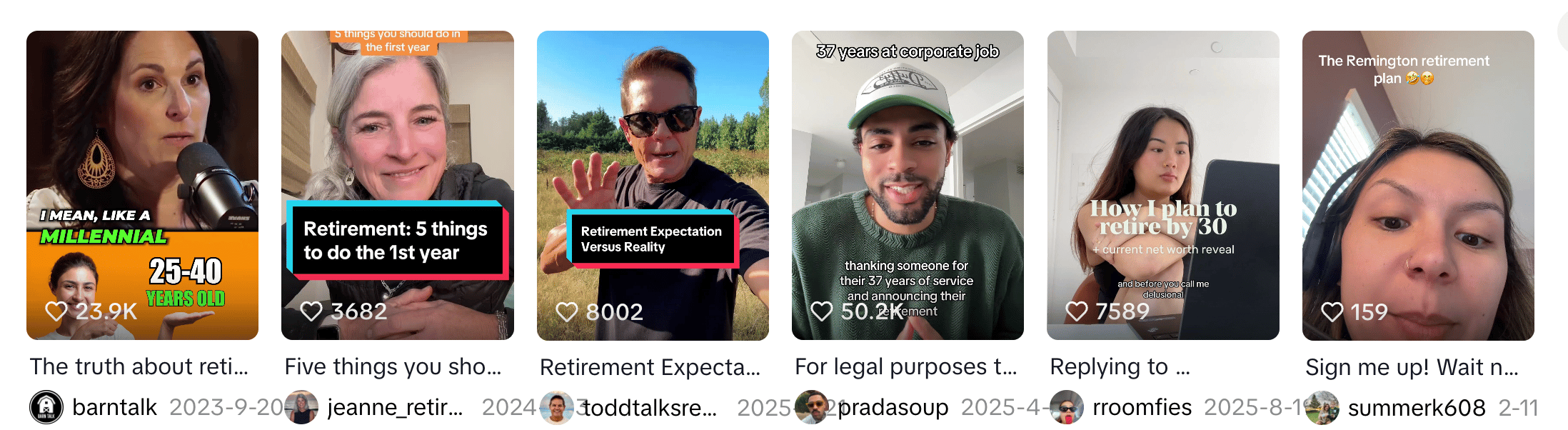
Go ahead and type “retirement” into the TikTok search bar.
What comes up isn’t people collecting a pension check at 65, or the Boca Raton retirement community dreamscape from Broad City.
It’s actually 30-somethings explaining why they’re trying to retire by 40, spreadsheet-obsessed FIRE (Financial Independence, Retire Early) devotees calculating their “coast number,” and a growing chorus of people admitting that the traditional version of retirement— the one we were all supposedly working toward— feels less like a goal and more like a myth.
And our Going Places community feels the same way.
I recently surveyed this newsletter audience about your career, your ambitions, and where you think all of this is headed.
When I asked what "end-of-career success" actually looks like for you, the responses stopped me in my tracks. Not because they were surprising, exactly. But because they confirmed something I'd been sensing for a while:
Retirement, as a concept, has lost its grip on our generation, and something messier, more personal, and more honest has replaced it.
Let's talk about what that is.


First, The Story in the Data
When asked about end-of-career success, the most common coded theme from Going Places readers was financial freedom — cited by nearly a third of all respondents.
Impact and legacy came in second, named by roughly one in five.
Less than one percent said end-of-career success looks like status and recognition.
Almost nobody in this audience is orienting their entire career around a corner office or a C-suite title. The prestige ladder that our parents climbed, the one we were told to want, has basically fallen off the list.
But here's what's interesting: financial freedom and retirement are not the same thing. And the way readers described financial freedom reveals a lot about what we're actually chasing.
The Retirement Dream Means Something Different Now
Some readers did want traditional retirement — early, comfortable, done:
“'Retiring by 55.”
“Early retirement.”
“Hitting my retirement savings number."
But for every response like that, there were two or three that described something more nuanced — less a finish line, more a feeling:
“Having enough money so that work is a choice, not a must.”
“Where my work doesn't feel like work.”
“Not working for someone.”
Notice the shift?
It's not necessarily, "I want to stop working."
It's more, "I want to stop working on terms that aren't mine."
That is a fundamentally different ambition, and it explains why "financial freedom" topped the list even among people who, elsewhere in the same survey, said they have no idea if they'll ever actually be able to retire.
Over half of Going Places readers — 52.7% — are under-saving for retirement or genuinely uncertain whether they're on track. And yet financial freedom still dominates as the end-goal.
Because for a lot of us millennials, financial freedom + optionality is the whole point. It's the thing that buys us the right to make a different kind of choice, whether it be early retirement, mini-retirements, or choosing to never retire because we’re having too much fun with our work (a concept!).
The People Who Rejected the Question Entirely
Some of the most telling responses were the ones that pushed back on the premise of "end-of-career" altogether:
“I have not really thought about this — I'm still trying to figure out what my 'career path' is when the concept of work while the country is falling apart is hard enough.”
“Who knows at this point. I think most of us are living rather day-to-day.”
“I never expect to fully 'retire' from the workforce or if I do, it will be very late (75+). I want to be doing aligned, interesting work until I can't anymore. Retirement feels out of reach.”
“I'm not sure what this means? Like before I retire? Working on projects I'm excited about and proud of and making more than enough money to just survive.”
There's something important in these responses. I see them as realistic rather than nihilistic.
A generation that entered the workforce during the Great Recession, lived through a pandemic that rewrote the rules of work entirely, and is now watching AI reshape entire industries doesn't have the luxury of a stable 40-year plan.
Day-to-day survival and long-term visioning are happening simultaneously, awkwardly, in the same body.
it would be easy to write this off as hopelessness, opting-out, or giving up, but I’m inclined to see it as something more hopeful — less linear, more iterative.
Less "this is the path" and more "this is what I want to feel."

I think me, retired, will look a lot like me at 3yo.
What We Actually Want (And Why It's Harder to Name)
Read enough of the qualitative surveyr esponses and a pattern starts to emerge.
When asked about end-of-career success, readers weren't describing a destination so much as a set of conditions:
“To still have a sense of self to go back to after years in the workforce.”
“Being able to afford the life I want without stress or worry.”
“Having learned and led along the way, while having meaningful real life experiences with people I love.”
“Knowing that I built a successful brand empowering women while staying present for my family, creatively fulfilled and financially free.”
Freedom. Presence. Impact. Identity. These seem more like life goals than retirement goals, no?
And the fact that they're showing up in a question about careers tells you something: for our generation, work was never supposed to be just a vehicle to fund a life we'd enjoy later.
We were told our careers would be central to who we are. And now we're reckoning with what happens when that promise collides with economic reality, with burnout, with the realization that the ladder had missing rungs all along.
The survey also showed that only 6.8% of Going Places readers describe their career as "thriving where I am."
But nearly a quarter are actively building something new.
Almost half are considering a pivot to a different industry in the next 12 months.
We are trying to redesign the whole career timeline, from the inside out, while still inside it.
So What Are We Actually Working Toward?
My read of the data: we are working toward optionality.
The ability to choose — how we spend our time, what we build, who we work for (or whether we work for anyone at all). The freedom that comes not from stopping work but from no longer being trapped by it.
And when you read the responses through that lens, even the ones that seem contradictory start to make sense together. "Retire by 55" and "I want to be doing aligned, interesting work until I can't anymore" are both expressions of the same underlying desire — to not be locked into a version of work you didn't choose.
One reader put it as cleanly as I've ever seen it:
“Coast FIRE — something where if my career ends or I'm fired I'll be ok.”
A psychological safety net, the thing that lets you take a risk, say no to something, or walk away from a job that's slowly making you someone you don't recognize.
Which, if you think about it, is what all the "starting over at 30" content is really about too. We want optionality, the ability to blow something up and still be okay on the other side.
We were handed a broken blueprint — one that promised security in exchange for loyalty, and then took the security away while keeping the loyalty requirement. Is it any wonder we stopped planning for the retirement that blueprint promised?

What This Means For How We Build Now
If optionality is the actual goal, then the moves that feel radical — building a side income, going freelance, investing in a personal brand, staying curious across industries — are actually the most rational responses to the environment we're in:
The survey bears this out too:
Among readers who are self-employed or business owners, the average work-ambition alignment score was 6.94 out of 10.
Among full-time employees, it was 5.08.
Among those between jobs, it dropped to 4.58.
Autonomy correlates with alignment. This doesn't mean everyone needs to quit their job and launch a newsletter, but it does suggest that the people who have designed more control into their work — even incrementally — feel more like themselves inside it.
Almost 9 in 10 Going Places readers are open to multiple streams of income. Over a third said "don't have a thing to sell" is what's stopping them — not a lack of desire, but a lack of clarity. That's a fixable problem.
And it's one worth solving, because the "thing you sell" is often just a packaged version of what you already know.
A Final Thought
One reader wrote: "happily retired and not thinking about 'career' at all."
Another wrote: "A Wikipedia article."
Both of those answers made me smile. Because they're both valid. Both are saying:
I want to have lived a life meaningful enough that I won't need to think about whether it was worthwhile.
The dream of retirement didn't disappear because this generation is lazy or unambitious or incapable of long-term thinking. It disappeared because the deal that underpinned it — work hard, stay loyal, receive security — got renegotiated without our input.
And now we're trying to write a new deal. One that centers on choice, contribution, and the ability to still recognize ourselves when we finally look up.
I don't think we millennials want to stop working (most days).
I think we want to stop working against ourselves.
I'm curious: what does the end of your career story look like right now — and how has that picture shifted from what you imagined even five years ago? Reply or leave a comment, I read everything!
— Janel

Love the newsletter but want more? Did you know I put together an entire course called Pivot with Purpose? Think of it like a supercharged version of all the best content from this newsletter, tailored to help you nail your career goals.
It’s about damn time you found a career that fits!

Pivot with Purpose is a self-paced online course that has helped 100’s of mid-career millennials land competitive roles in marketing, non-profit management, venture capital, and more! Unlock customizable networking scripts, interviewing & negotiation resources— most Pivoters earn back their investment in the course with their first negotiated offer! Don’t leave clarity, confidence- or cash- on the table.


Reply